In 1992 during a visit to Paris, the city was preparing to celebrate the fiftieth anniversary of liberation of Paris during World War II. It seemed to me that the story of the liberation from the French point of view was not completely accurate. I knew from first hand experience that the Americans liberated France and thus Paris as well. Also, as a Jew, I knew about the French complicity in rounding up Jewish families and sending them to concentration camps. As of 1992 the French had never admitted that they had any part in it. I remember a book that we had right after the war that shows the French gendarmes marching heroicly down the Champs Elisee on August 25, 1944 after Paris was liberated. The week before they had been rounding up Jews for deportation. The last train to the camps left August 24, 1944.
I decided I would do a set of murals celebrating the Liberation from a Jewish point of view. I wanted to have a show of the murals in the Salle des Fêtes in the Mairie of the 11th arrondisment where my family had lived. The 11th was a Jewish neighborhood that was emptied during the war. The show never happened, but I decided to do the murals anyway
There are seven murals because that’s the number that would have fit in the Salle des Fêtes. They represent what I thought were important events of the war for French Jews.
Philip Orenstein
D-Day June 6, 1944
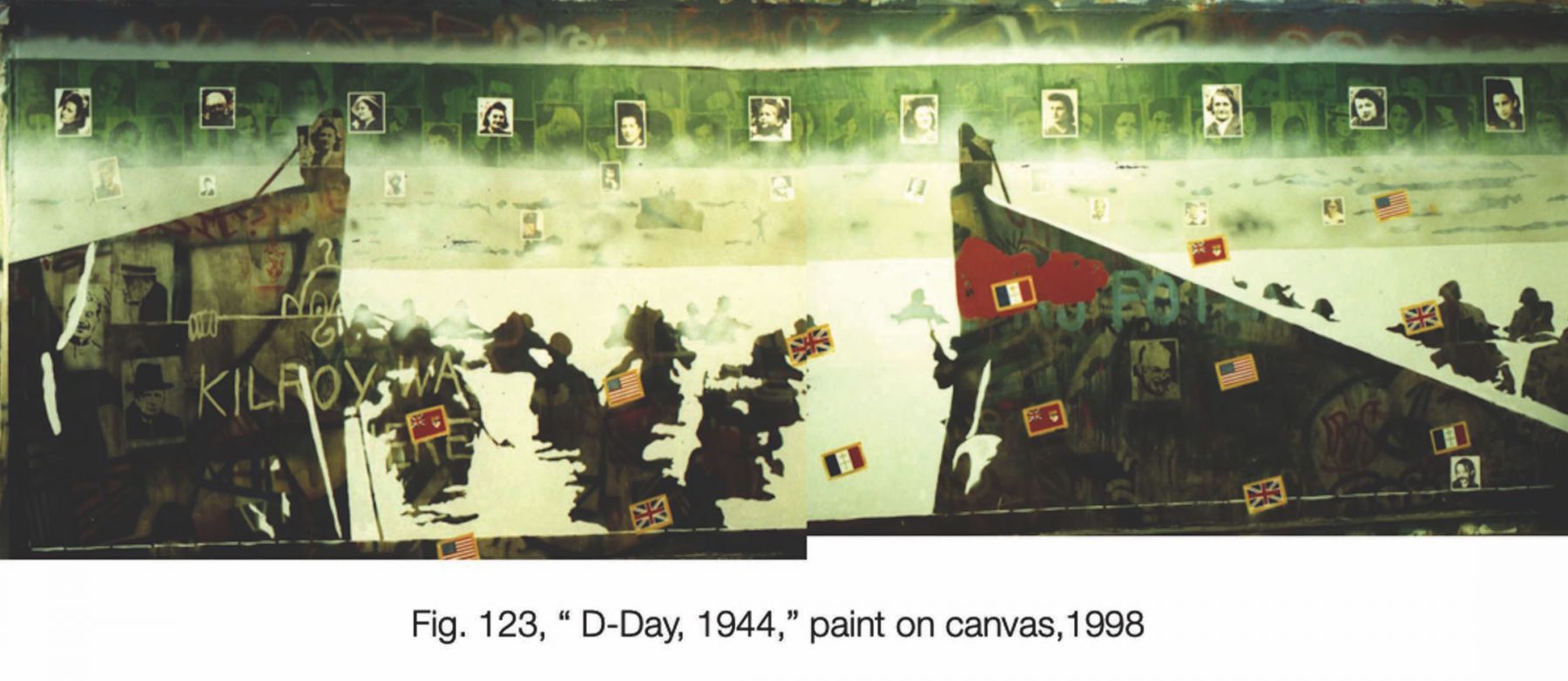
The artist places the viewer in a landing craft about to follow the soldiers into the water and onto the beach of Normandy. Across the top the images of women is meant to recognize the role women played in the war. Women at that time took on different roles, some good, some not so good, but some were helplessly caught in the tragedy that was happening. There are pictures of women who were defense workers, pilots, spies, soldiers, war brides, deportees, collaborators, entertainers like Lena Horne and Marlene Dietrich, intelligence workers like Julia Child, and the women in the artist family.