In 1992 during a visit to Paris, the city was preparing to celebrate the fiftieth anniversary of liberation of Paris during World War II. It seemed to me that the story of the liberation from the French point of view was not completely accurate. I knew from first hand experience that the Americans liberated France and thus Paris as well. Also, as a Jew, I knew about the French complicity in rounding up Jewish families and sending them to concentration camps. As of 1992 the French had never admitted that they had any part in it. I remember a book that we had right after the war that shows the French gendarmes marching heroicly down the Champs Elisee on August 25, 1944 after Paris was liberated. The week before they had been rounding up Jews for deportation. The last train to the camps left August 24, 1944.
I decided I would do a set of murals celebrating the Liberation from a Jewish point of view. I wanted to have a show of the murals in the Salle des Fêtes in the Mairie of the 11th arrondisment where my family had lived. The 11th was a Jewish neighborhood that was emptied during the war. The show never happened, but I decided to do the murals anyway
There are seven murals because that’s the number that would have fit in the Salle des Fêtes. They represent what I thought were important events of the war for French Jews.
Philip Orenstein
Battle of Stalingrad 1943
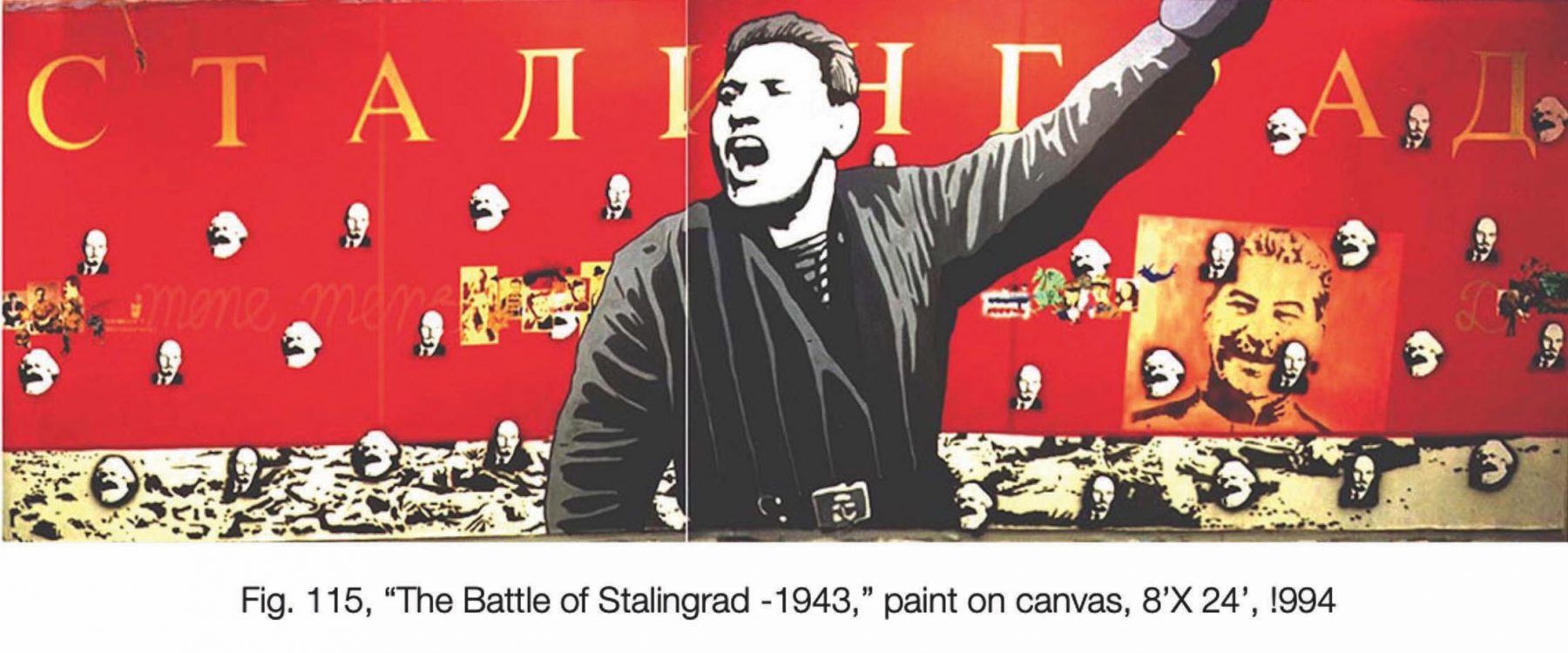
Much of French public opinion changed rapidly after news arrived that the German army had been badly defeated at Stalingrad in the USSR. Many saw this as the beginning of the end for the Nazis and thought twice before collaborating with the occupiers and persecuting Jews. On the mural the word Stalingrad appears in Cyrillic in large gold letters mimicking a Soviet poster. In the middle a Russian soldier calls his troops to action. Images of Marx and Lenin form an ironic pattern suggesting that the painting was done at the time of the fall of the Soviet system. The four groups of images represent, from left to right, Russian soldiers from the battle of Stalingrad, the artist’s family, France and the United States.