In 1992 during a visit to Paris, the city was preparing to celebrate the fiftieth anniversary of liberation of Paris during World War II. It seemed to me that the story of the liberation from the French point of view was not completely accurate. I knew from first hand experience that the Americans liberated France and thus Paris as well. Also, as a Jew, I knew about the French complicity in rounding up Jewish families and sending them to concentration camps. As of 1992 the French had never admitted that they had any part in it. I remember a book that we had right after the war that shows the French gendarmes marching heroicly down the Champs Elisee on August 25, 1944 after Paris was liberated. The week before they had been rounding up Jews for deportation. The last train to the camps left August 24, 1944.
I decided I would do a set of murals celebrating the Liberation from a Jewish point of view. I wanted to have a show of the murals in the Salle des Fêtes in the Mairie of the 11th arrondisment where my family had lived. The 11th was a Jewish neighborhood that was emptied during the war. The show never happened, but I decided to do the murals anyway
There are seven murals because that’s the number that would have fit in the Salle des Fêtes. They represent what I thought were important events of the war for French Jews.
Philip Orenstein
Liberation of Paris August 25, 1944
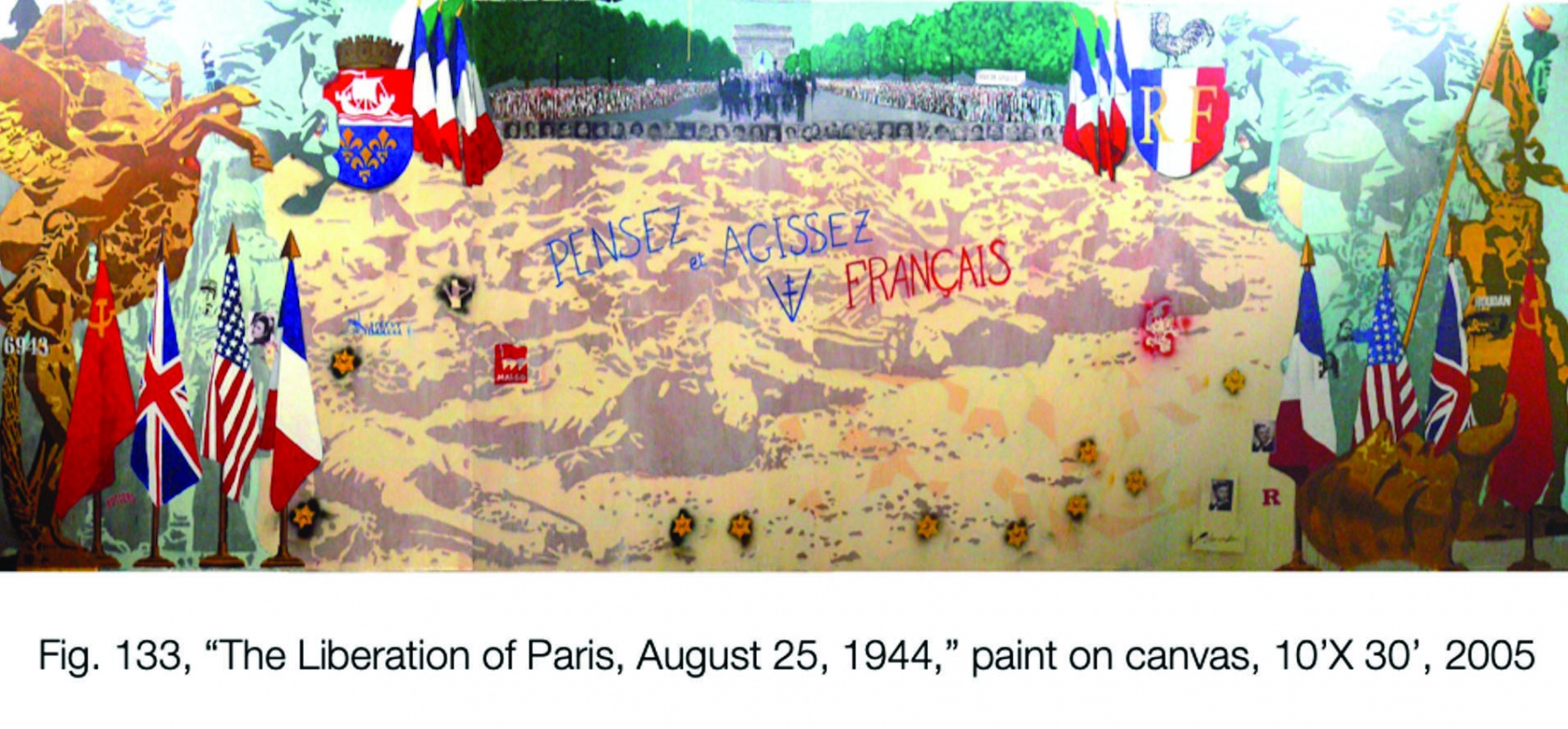
The last mural in the series is the Liberation of Paris August 25, 1944. This mural is an attempt at summing up the series of murals. It’s partly homage to the Americans who liberated France, but it’s also a critique of the French myth that they liberated Paris. De Gaulle and the Free French forces were on the side of the Allies, but the Jews of France cannot forget that the French police were as dangerous as the Nazis. The painting is celebratory; it takes the form of a proscenium stage with Parisian statues relating to America forming the arch. The Liberation parade down the Champs Elysee with De Gaulle in the lead occupies the top two feet. Immediately below that are pictures of forty French Jewish children standing in for the 4,000 children who were rounded up in the Vel d’Hiv raid and never came back. In center stage is a faded picture of dead bodies from a concentration camp. The inion is a bit of graffiti photographed by Varian Fry in Marseilles written on the wall by the French Resistance, which warns people “Pensez et agissez Francais,” (Think and act French). At least the way the French ought to act.