Fall of Paris

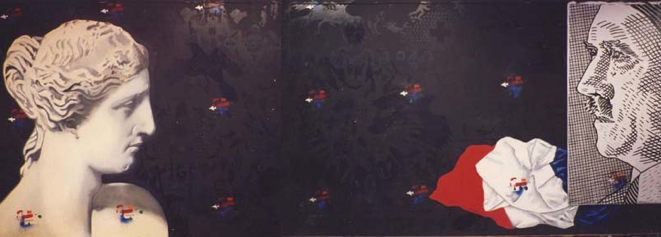
In June of 1940 the German Army occupied Paris. This was a great prize for art-loving Hitler. The mural refers to the time, shortly after the beginning of the occupation, when he visited the city to look over his booty. It represents symbolically his visit to the Louvre Museum to observe the captive Venus de Milo, which here stands for France. Crows or Ravens included in the imagery are a reference to the French Resistance’s anthem, which begins “O friend do you hear the song of the crows on the plain.” The crow in this case is an ominous vision of the danger to come. The image of the man holding a number is a copy of the artist’s father’s identification picture with the number on his German prisoner of war documentation. The word “violin’ appears, representing the profession of his mother. The number 6943 is an art historical reference to a painting by the Italian Futurist Umberto Boccioni called States of mind: The Farewells, 1911. It represent abstractly the departure of a troop train with that number. That number is used throughout the murals. Trains during World War II moved munitions, soldiers, prisoners of war, and deported Jews.
# 1. Fall of Paris June 14, 1940 1994 Paint on Canvas 7’ X 20’